
Robin MacCormack
The Story of Boston’s First LGBTQ+ Liaison and the Boston Tea Party 2 ½ Protest
by Fiona Charlson
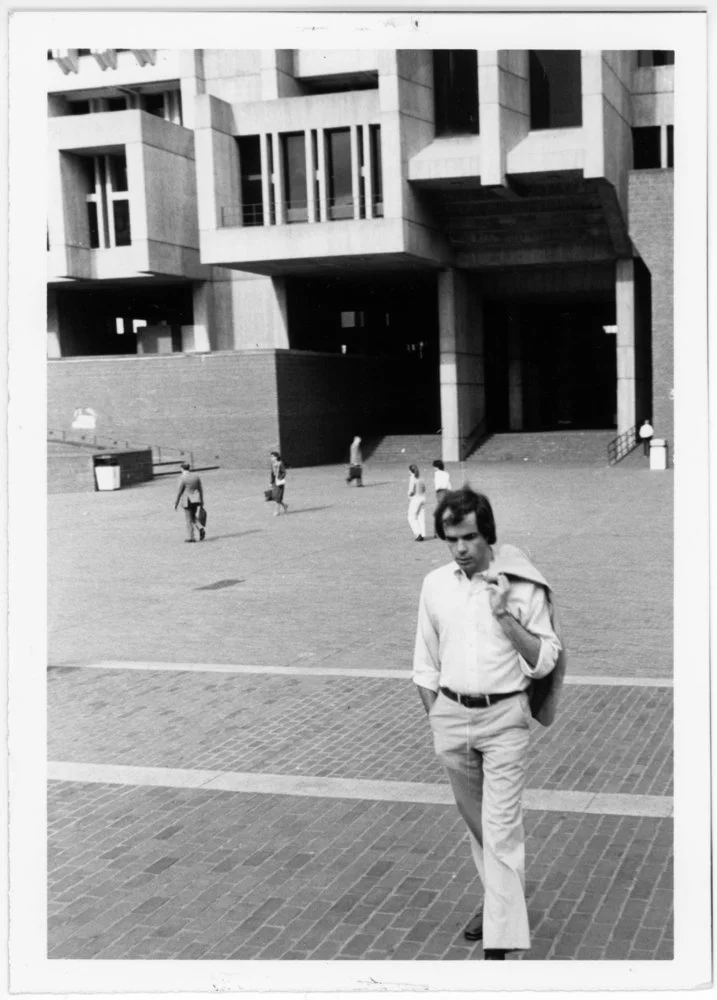
Joyce Harper, “Robin MacCormack by City Hall,” Ca. 1981. Coll. 104 Gay Community News Photograph Collection, Queer History Boston.
On June 16, 1981, a defeated Robin MacCormack walked away from the Boston City Hall after an unsuccessful plea to save his position as the Mayoral Liaison to the Lesbian and Gay community of greater Boston.
When MacCormack began this position two years prior in 1979, it was the first queer liaison position to exist not only in Boston, but in all of the United States [1]. At the time, there was rising violence against gay men in Boston [2]. This position stemmed out of MacCormack’s work with the Boston Police Department where he trained and educated officers about the LGBTQ+’s community needs.
According to David Morris, a former writer for Gay Community News, MacCormack also aided in investigations by acting as a spokesperson for members of the community who would not communicate directly with the police [3]. Queer community members expressed being “pleased that MacCormack made fighting violence a priority of his undefined position” and supported him immensely [4]. Despite his powerful community work, in January of 1981, a Boston magazine reported a rumor that MacCormick would be fired as a result of Proposition 2½ [5].
If you are enjoying this mini deep-dive of local LGBTQ+ history, please consider donating to Queer History Boston!
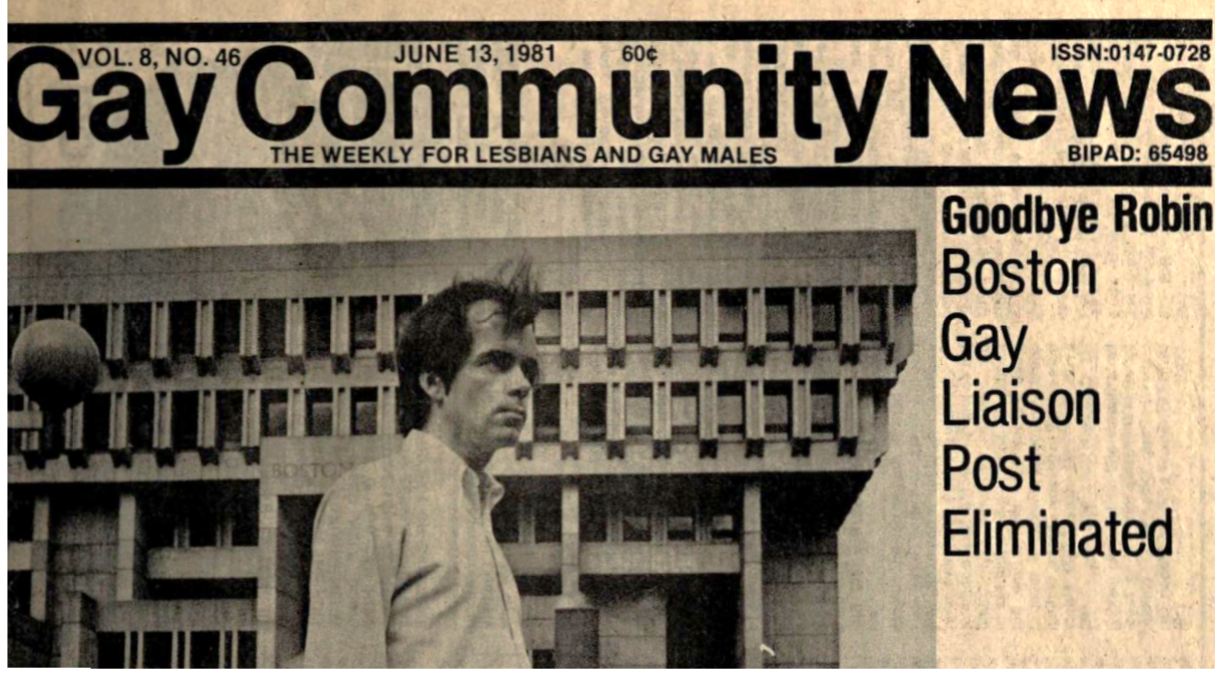
Front Page: "Goodbye Robin: Boston's Gay Liaison Post Eliminated." Gay Community News, Vol. 8. No. 46, June 13, 1981. Coll. 016 Gay Community News Publication Collection, Queer History Boston.
Proposition 2 ½
Proposition 2½ was proposed and passed in 1980 and featured a number of controversial tax regulations strictly limiting municipal tax levies [6]. The resulting budget cuts led to city-wide layoffs, including the elimination of MacCormack’s liaison position.
However, not all city council members supported White’s decision to cut the liaison position. In one meeting, City Councillor Rosemarie Sansone “noted that the $14,000 yearly salary the position costs the city is relatively small” [7]. Nonetheless, on Friday, May 29, 1981, MacCormack was notified he would be laid off. This threat was not taken too seriously at the time by MacCormack though, who told Gay Community News “he had received termination notices on several occasions that had later proven to be false alarms” [8].
Michael Donovan, a press aide to Mayor Kevin White, stated that the post was eliminated for purely financial reasons, but some of MacCormack’s supporters argued that he was let go because he “refused to join the [Kevin] White Machine and devote large amounts of time to raising gay followers for Kevin White” [9]. Others speculated that White “created the liaison position in the first place to draw on votes from the gay and lesbian community” when he initially ran for mayor [10].
Community Outcry
MacCormack and his supporters did not back down. Katherine Triantafillou, a friend of MacCormack’s and the first openly gay person to practice law privately in Massachusetts [11], reminded city hall and community members “that the option of bringing a suit against the city had not been ruled out” [12]. She also urged her audience to telephone city hall, write to the mayor, and initiate active demonstration. On his final day, MacCormack walked out of City Hall with Triantafillou at his side.
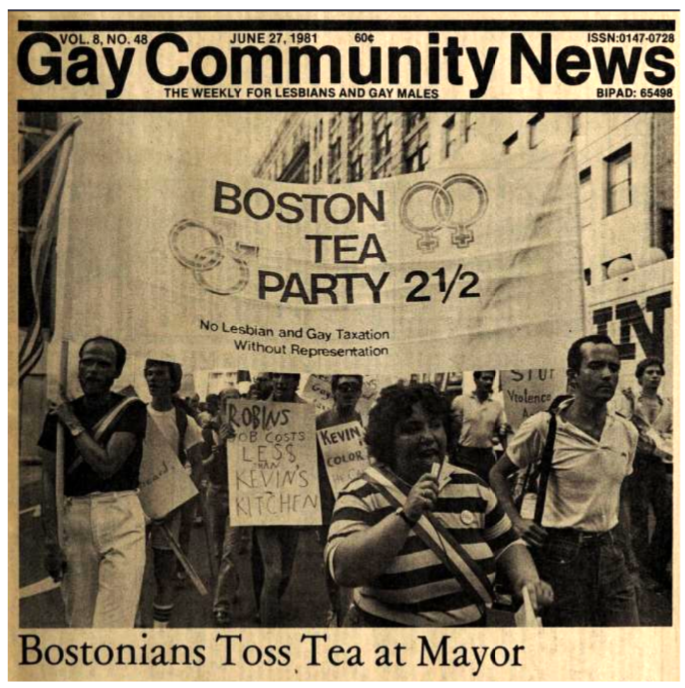
Front Page: "Bostonians Toss Tea at Mayor." Gay Community News, Vol. 08, No. 48, June 27, 1981. Coll. 016 Gay Community News Publication Collection, Queer History Boston.
Eric E. Rofes, a gay activist who helped establish queer organizations in Boston, Los Angeles, and San Francisco, drew attention to how the elimination of the position was happening at a dangerous time for queer individuals [13]. That spring had already seen half a dozen murders of gay men in the Boston area, and summers were known for increased street violence against lesbians and gay men [14]. Rofes also pointed out that additional cutbacks of police officers included "virtually all the officers hired over the past two years - the only officers to have received considerable training on assisting the lesbian and gay population" [15].
Not only was White removing MacCormack, but also the police officers he trained as liaison. Rofes declared that “by the elimination of the position, White sends a loud and clear message to the lesbian and gay community: our issues are not as important as Kevin’s machine; people serving the White Machine are welcome aboard; - people serving the gay community, we can’t afford” [16].
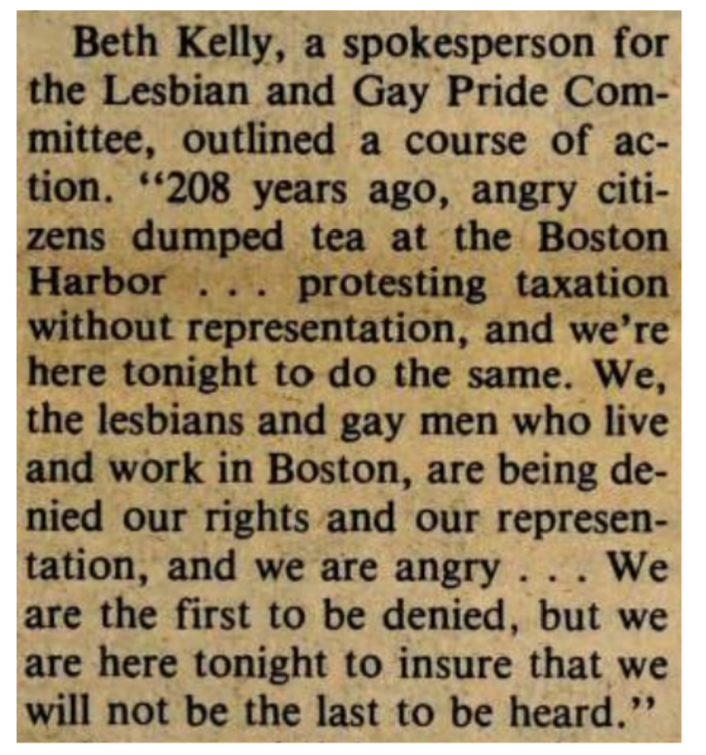
Larry Goldsmith, "Community Demonstration Against Mayor White Over Loss of Liaison." Gay Community News, Vol. 08, No.48, June 27, 1981, p. 3. Coll. 016 Gay Community News Publication Collection, Queer History Boston.
Boston Tea Party 2 ½
When June 16th came, according to Gay Community News, “approximately 100 people gathered at City Hall to demonstrate against Mayor Kevin H. White’s elimination of the mayoral liaison to the lesbian and gay community” [17]. Demonstrators cheered and waved placards proclaiming “No Taxation without Representation” and “Robin’s Job Costs Less than Kevin’s Kitchen” [18]. Afterward, the “crowd then marched through rush-hour traffic to the recently remodeled, city-owned Parkman House and showered the steps with teabags,” referring to it as the Tea Party 2½ [19].
When supporters covered the Parkman House’s steps with tea bags, they evoked the same principle that defined this city and country: no taxation without representation. They also illuminated what the elimination really represented: not a financial necessity, but a political choice. In a final statement, MacCormack thanked supporters and told them “the office in there did not belong to me — it belonged to all of us, and we have to do our damndest to get it back” [20].
Reinstatement Promises
By the end of the summer (August 12, 1981), Deputy Mayor Katharine Kane promised MacCormack’s position would “be reinstated if the Boston City Council and the Massachusetts State Legislature pass the mayor’s latest solution to the city’s budgetary crisis” [21]. In addition to this, the Tregor Home Rule Petition proposed to fund the liaison position by offsetting revenue costs with bonds and various taxes [22].
In late August, citing a report by the Boston Municipal Research Bureau, Councilor Joseph Tierney proposed that the city could afford to operate without layoffs, even if the Tregor bill did not pass [23]. Sadly, the Tregor Bill was shot down, and the budget cuts were enacted across Boston. Still, the queer community continued to fight, along with the many others who were laid off.
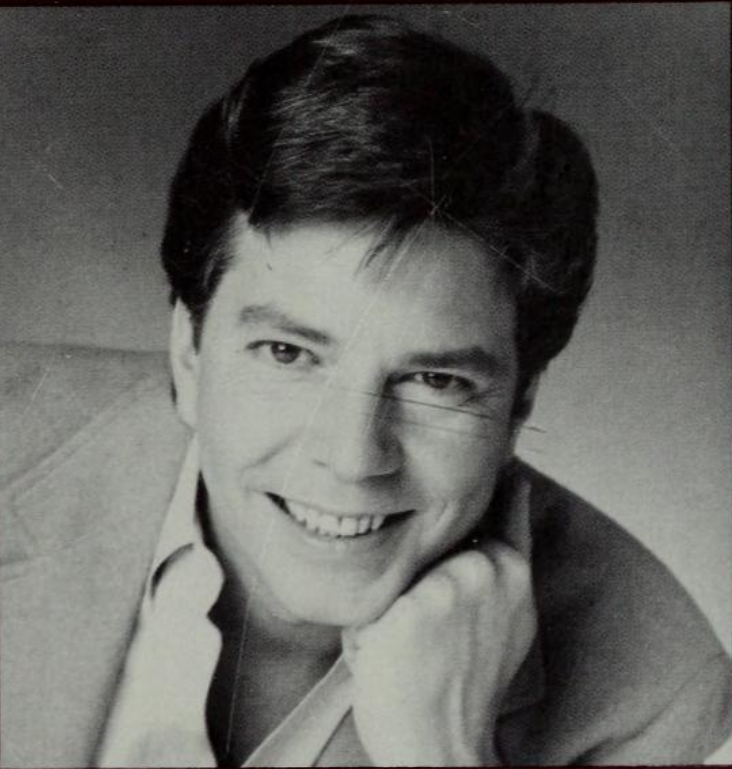
Brian NcNaught from his book "On Being Gay," 1989. Courtesy of St. Martin's Press.
Legacy of the Position
After six months of back-and-forth between city hall and the gay community, White agreed to reinstate the position. He increased the salary to $25,000, supported efforts for an LGBT community center, and aimed to “appoint a lesbian or gay man to the city Health and Hospitals Commission, issue a new executive order based on the Tea Party 2 ½ Committee’s proposed draft of a gay rights ordinance, and work with committee members” [24].
Even with these new promises, McCormack did not return. Instead, almost exactly a year after MacCormack left, White revealed on June 11, 1982, that he appointed Brian McNaught as the new liaison to the lesbian and gay community [25]. A few days later, at the 12th annual lesbian and gay pride march and rally, McNaught announced that Mayor White would sign a new executive order to prohibit discrimination by the city on the basis of sexual orientation, something that would have seemed unlikely the year before [26].
Boston City Hall’s—specifically Mayor Kevin H. White’s—creation, elimination, and then reinstatement of the mayoral liaison to the lesbian and gay community illustrates how queer individuals have been used as political pawns to gain votes and perceived support. Queer rights often teeter on the knife’s edge, rarely guaranteed and easily removed when convenient. While White took a step in the right direction during the final months of his term, his mayoral position is marked by the questionable decisions made during the three years prior. Robin MacCormack’s efforts were immensely valuable to not only Boston’s queer community, but also for setting an example to the rest of the country as to how city officials should support all members of their community.
The Mayoral Liaison to the Lesbian and Gay Community continued to be an important representative to the community, and many more people took on the role as the years went on. The following lists subsequent liaisons and the Mayors under which they worked [27].
Robert MacCormack - Mayor White
Brian McNaught - Mayor White
John Meunier - Mayor Flynn
Ann Maguire - Mayor Flynn
Ann Sanders - Mayor Flynn
John Affuso - Mayor Menino
Mark McGrath - Mayor Menino
Mike Kelly - Mayor Menino
Jamie Hoag - Mayor Menino
Karen Fried - Mayor Menino
Sam Chambers - Mayor Walsh
Jullieanne Doherty Lee - Mayor Walsh, Mayor Wu
Quincy Roberts Sr. - Mayor Wu
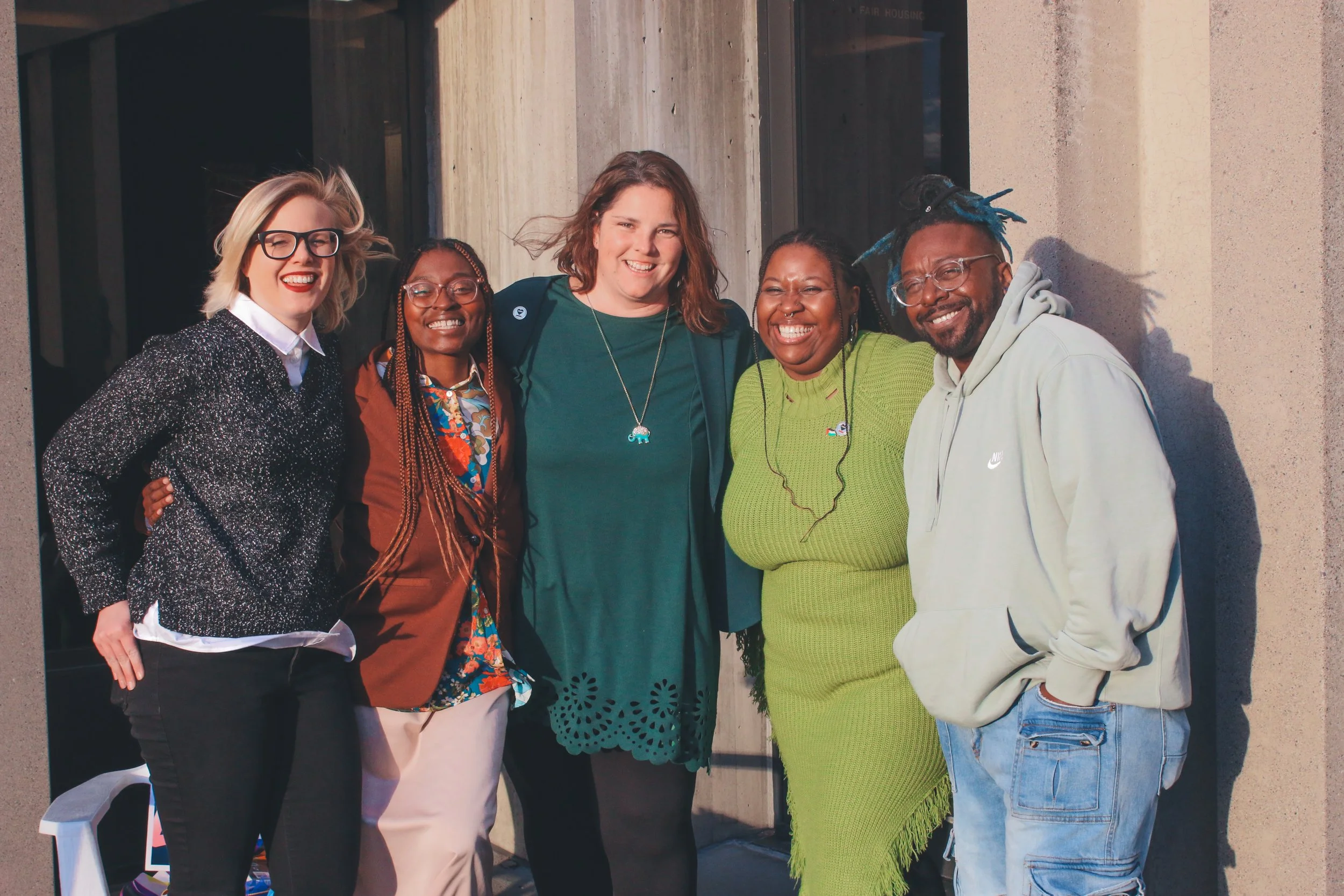
The Mayor’s Office of LGBTQIA2S+ Advancement. From left to right: Kimberly Rhoten, Viola Dean, Jullieanne Doherty Lee, Daunasia Yancey, Justice Williams
Today - The Mayor’s Office of LGBTQIA2S+ Advancement
The Liaison position lasted through 2022, when the Mayor's Office of LGBTQIA2S+ Advancement was created by Mayor Wu. The last liaison to the community was Quincey Roberts Sr., who was appointed MOLA's first Executive Director [28]. Their mission statement describes their commitment to the development of “policies, community-oriented programming, and provides resources for the City’s diverse LGBTQIA2S+ community” [29].
In 2024, Jullieanne Doherty Lee took over MOLA with her team (Daunasia Yancey, Kimberly Rhoten, Justice Williams, and Viola Dean) and have been an impactful resource in the community. Each year, they have given away over 200k in community grants and founded the MOLA partner network to bring together LGBTQ+ organizations across Boston.
Enjoyed this glimpse into Boston's LGBTQ+ history?
Come visit Queer History Boston and see what stories you can bring out of the archives!
Notes
David Morris, "Liaison Position Axed", Gay Community News, Vol. 08, No. 46 June 13, 1981.
Morris, "Liaison Position Axed", p.1. Quote from Gay activist Joe Martin.
Ibid, p.1.
Eric E. Rofes, Speaking Out: You Can Fight City Hall. Vol. 08, No. 46 June 13, 1981, p.5.
Morris, "Liaison Position Axed", p.1.
What is Proposition 2 ½ ? Frequently asked questions, Hingham Town Hall. Accessed 5/15/2026
Morris, "Liaison Position Axed", p.1.
Ibid, p. 3. // all good
Rofes, Speaking Out: You Can Fight City Hall, p.5.
Morris, "Liaison Position Axed", p.3.
“Triantafillou, Katherine.” Katherine Triantafillou papers, Sophia Smith Collection of Women’s History, Identifier SSC-MS-00632. Smith College Special Collections.
Jon Marcus. Gays, Lesbians Vow March on Mayoral Aide's Dismissal.Boston Globe, Jun 10, 1981, p. 22.
Douglas Martin. June 29, 2006. Eric Rofes, Commentator on Gay Issues, Dies at 51. The New York Times.
Rofes, Speaking Out: You Can Fight City Hall, p.5.
Ibid.
Ibid.
Larry Goldsmith. Community Demonstrates Against Mayor White Over Loss of Liaison. Gay Community News Vol. 08, No. 48 June 27, 1981, p.1.
Ibid.
Ibid.
Ibid.
Larry Goldsmith. Boston Promises Reinstatement. Vol. 09, No. 07 August 29, 2981 p.1.
Goldsmith. Boston Promises Reinstatement, p.1.
Ibid.
Larry Goldsmith, Mayor Appoints Brian McNaught as New Liaison. Gay Community News. June 26, 1982 (Vol. 9, no. 48). p. 3.
Goldsmith, Mayor Appoints Brian McNaught as New Liaison. p. 3.
Larry Goldsmith. Pride Reigns in Boston; Mayor’s Executive Order Announced at Pride Rally. Gay Community News, July 3rd, 1982 (Vol. 9, no. 49). P. 1.
Schmitz, Dawn. New Liaison Appointed; an Interview with John Meunier, Boston Mayor Ray Flynn's New Liaison to the Lesbian and Gay Community. Gay Community News, Aug 31, 1991, 3; Trudy Ring, Pioneering LGBTQ+ activist Ann Maguire has died at 80. Advocate, Obituaries. Jan 29, 2024; Ann Sanders, City of Boston. Accessed May 31, 2026; Alexander J. Blenkinsopp, Menino Easily Wins Reelection. The Harvard Crimson, The University Daily. Nov 7, 2001; How I’ll Fight for a Healthier Boston: Mike Kelly for City Council. Planned Parenthood Advocacy Fund of Massachusetts. Nov 1, 2017. 30.
Susannah Sudborough. “Mayor Wu creates Boston Office of LGBTQ+ advancement, appoints first director.” Boston.com. June 1, 2022.
The Mayor’s Office of LGBTQIA2S+ Advancement, City of Boston. Accessed 5/26/2026.
Bibliography
Devall, Cheryl and Marcus, Jon. "Gays Protest Robin MacCormack Layoff." Boston Globe (1960-), Jun 17, 1981. Gays Protest Robin MacCormack Layoff, p. 25.
Goldsmith, Larry. Community Demonstrates Against Mayor White Over Loss of Liaison. Gay Community News Vol. 08, No. 48 June 27, 1981. https://archive.org/details/gaycommunitynews0848gayc/page/n1/mode/2up
Goldsmith, Larry. Boston Promises Reinstatement. Vol. 09, No. 07 August 29, 2981. https://archive.org/detailsgaycommunitynews0907gayc/mode/2up
Goldsmith, Larry. Tregor Bill Dies; New Liaison Not Likely. Gay Community News, Vol. 09, No. 12 October 10, 1981, p.3. https://archive.org/details/gaycommunitynews0912gay c/page/2/mode/2up
Goldsmith, Larry. Mayor Appoints Brian McNaught as New Liaison. Gay Community News. June 26, 1982 (Vol. 9, no. 48). p. 3. https://archive.org/details/gaycommunitynews09 48gayc/page/n1/mode/2up.
Goldsmith, Larry. Pride Reigns in Boston; Mayor’s Executive Order Announced at Pride Rally. Gay Community News, July 3rd, 1982 (Vol. 9, no. 49). p. 1. https://drive.google.com/filed/1KT6Fue3PJBhKUhUzG7PGAWKkcMl-a2fW/view
Harper, Joyce. Robin MacCormack by City Hall. Queer History Boston, accessed May 11, 2026, https://historyproject.omeka.net/items/show/1563
Marcus, Jon. Gays, Lesbians Vow March on Mayoral Aide's Dismissal. Boston Globe, Jun 10, 1981, p. 22. https://www.proquest.com/newspapers/gays-lesbians-vow-march-on-mayoral -aides/docview/1011825954/se-2?accountid=14434
McMahon, Paul. Robin MacCormack in front of City Hall, Queer History Boston, accessed May 11, 2026, https://historyproject.omeka.net/items/show/1564.
Morris, David. Liaison Position Axed. Gay Community News, Vol. 08, No. 46 June 13, 1981. https://archive.orgdetailsgaycommunitynews0846gayc/page/n1/mode/2up.
Rofes, Eric. Speaking Out: You Can Fight City Hall. Vol. 08, No. 46 June 13, 1981. https:// archive.org/details/gaycommunitynews0846gayc/page/n1/mode/2up.
Sudborough, Susannah. “Mayor Wu creates Boston Office of LGBTQ+ advancement, appoints first director.” Boston.com. June 1, 2022The
Mayor’s Office of LGBTQIA2S+ Advancement, Accessed 5/26/2026. https://www.boston.gov/departments/lgbtqia2s-advancement
What is Proposition 2 ½? Frequently asked questions, Hingham Town Hall. Accessed 5/15/2026. https://www.hingham-ma.gov/m/faq?cat=38#question-314.
